

Giulia Galli
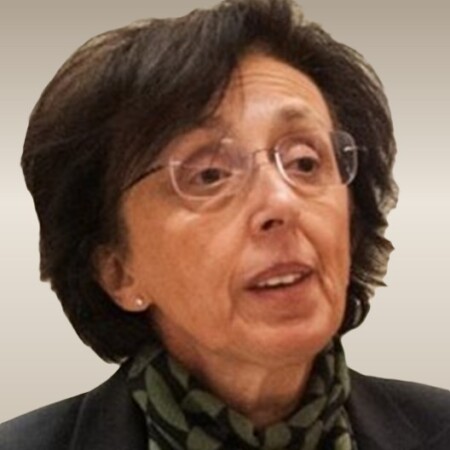
UChicago & Argonne
Professor ME & Chemistry
Giulia Galli is the Liew Family Professor of Molecular Engineering and Chemistry at the University of Chicago and a Senior Scientist at Argonne National Laboratory, where she is the director of the Midwest Center for Computational Materials (MICCoM). She is one of the world’s leading scientists in computational materials discovery, renowned for pioneering first‑principles simulations of solids and liquids, quantum‑theory‑driven design of materials for energy and quantum technologies, and predictive modeling of systems operating under extreme conditions. Galli has authored more than 500 publications and is among the most cited theoretical materials scientists globally, with major contributions spanning quantum information and sustainable energy. A member of the National Academy of Sciences, the American Academy of Arts and Sciences, and the International Academy of Quantum Molecular Science, she continues to shape the future of materials for quantum technologies and space exploration.
2026 CME NASA Symposium Abstract
Behind the scenes: stories of atoms forming next generation materials
Giulia Galli, University of Chicago & Argonne National Laboratory
Materials are enablers of innovation and have brought about revolutionary changes to society: familiar examples are silicon used in transistors and metal oxides in batteries, devices that have become omnipresent in our daily lives. In this talk we explore how the fundamental understanding of the way atoms interact in materials and molecules leads to predicting forms of matter that enable next generation technologies. We combine quantum mechanical theories, high performance computations and, through close collaborations with experiments, we design integrated, predictive strategies for materials design. I will touch upon several challenging problems: the discovery of radically novel systems for quantum technologies, specifically for quantum sensing and communications and of materials for low-power electronics and sustainable AI computing.